
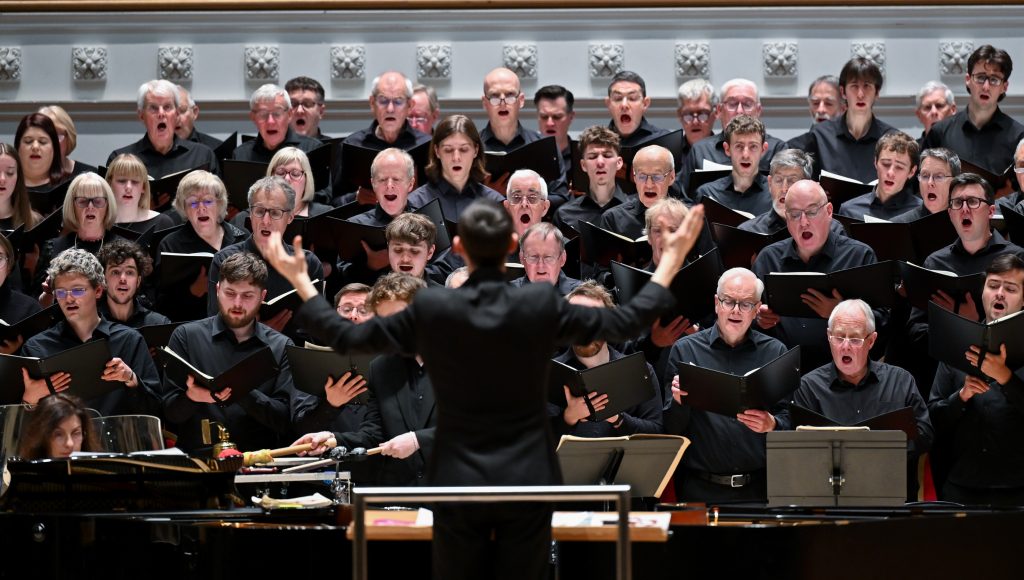
 Bearsden Choir, Credit Julie Howden
By Luke Hall and Ben Saffell
As a new parliamentary session begins, government ministers have their centrepiece legislative programme planned for the coming months. Beyond the headline measures set out in the King’s speech, Ministers, alongside backbench MPs, will also be looking for practical, deliverable ways to support communities, drive growth, and strengthen sectors such as the UK’s world leading creative industries.
One such opportunity is hiding in plain sight, packaged up, and ready to deliver: an anomaly in the creative tax reliefs system that unfairly excludes choirs.
Orchestra Tax Relief has been one of the quiet successes of UK cultural policy. Introduced in 2016, it has helped amateur and professional orchestras across the UK increase production budgets, employ more freelance musicians, reach new audiences and strengthen local cultural economies. Government ministers rightly point to these reliefs as among the most generous and effective in the world.
Yet choirs, one of the most beautiful, accessible and socially valuable parts of our creative ecosystem, remain locked out.
The problem is surprisingly narrow. The legislation allows the reliefs to apply to concerts performed either ‘wholly or mainly’ by instrumentalists. But HMRC have determined that the human voice is not treated as an instrument for these purposes. This creates an inconsistency within the creative tax reliefs framework: vocal performance already qualifies for relief elsewhere, including under Theatre Tax Relief for opera and musical theatre, yet choirs producing live acoustic concerts remain excluded.
The result is an odd and unfair situation: an orchestra can claim tax relief for a concert that includes a choir, but a choir producing its own choral concert cannot claim at all.
This distinction is difficult to justify in artistic, economic or policy terms. Choirs operate on almost exactly the same production model as orchestras. They rehearse year-round, hire venues, engage professional conductors, accompanists and soloists, pay for music hire and licensing, and perform live, acoustic concerts, often on a not-for-profit basis delivering deep and longstanding community benefits.
The exclusion of choirs remains a consequence of how “orchestral performance” was originally defined in legislation. After nearly a decade, that technical distinction now looks increasingly hard to defend.
At heart, this is a question of fairness. Two organisations doing fundamentally the same thing, producing live, acoustic musical performances for the public, are treated differently by the tax system based solely on whether sound comes from instruments or voices. For amateur choirs in particular, the impact is tangible. Many operate on slender margins, run by volunteers, and depend on modest ticket sales and fundraising.
Evidence from the orchestral sector shows that access to tax relief can increase production budgets by around 50% over time, allowing ensembles to put on more concerts, perform a wider range of music, pay professionals more fairly, and make performances accessible to more people. Ministers are right to point to the significant impact that creative sector tax reliefs have had in Britain. Now choirs deserve the same opportunity.
Choirs exist in every constituency across the country: urban, rural, affluent or deprived. Treating voice as an instrument cuts across age, health and education systems, supports all types of community, and delivers economic growth indiscriminately. There are few interventions in cultural investment terms which carry so much support and offer such wide and deep impact.
In economic terms, increased production activity means more work for freelance musicians, composers and music directors, greater use of local venues, and knock on spending in hospitality and nighttime economies. Evidence submitted to government suggests the cost to the Exchequer would be modest, less than £2 million annually, with much of that offset by additional income tax and VAT receipts as activity grows.
There are also well‑documented public health benefits. Singing is strongly linked to improved mental wellbeing, reduced loneliness, and better respiratory health, and choirs are increasingly part of social prescribing schemes. Supporting the sustainability of choirs is therefore not only a cultural investment, but a preventative one that can ease pressure elsewhere in the system.
What makes this moment particularly important is that political interest is clearly growing.
Ministers have recently reaffirmed their support for cultural tax reliefs and their willingness to consider evidence‑based improvements. The government’s response to the recent review of Arts Council England explicitly acknowledges the value of these reliefs and confirms that DCMS will work with HM Treasury to assess proposals for change.
At the same time, MPs from across parties are engaging constructively with the issue. Written parliamentary questions have already highlighted the inconsistency between different creative tax reliefs, and there is interest in fixing this issue through a Private Members’ Bill if government time is not immediately available.
Crucially, this is not a complex or radical reform. It would require a small amendment to existing legislation, for example, recognising “voice” alongside instruments for the purposes of Orchestra Tax Relief, building on the frameworks which already exist.
This is not about creating a new scheme from scratch, nor about special pleading from one corner of the arts. It is about completing the logic of a policy that Parliament has already endorsed, and which is otherwise delivering significant benefits.
At the start of this new parliamentary session, there is a genuine opportunity for government, MPs and the sector to work together to resolve a longstanding inequity. Doing so would be a sensible next step in the evolution of creative sector tax reliefs in the tax system to ensure they continue to deliver clear economic, social and cultural returns.
Choirs are one of the most cultural activities in the UK. Giving them equal access to creative tax reliefs would be a small legislative change, but one which would deliver a lasting and positive impact to all corners of our country.
This article was originally published in Arts Professional on 27 June